Archive for the ‘All Things Power Spread’ Category

Ironically, the Steelers, who were the first playoff victim of the PS in the NFL, arguably ran the first NFL PS back when they had a player they called Slash. The offense was an accident, but credit must be given to the open mindedness of Bill Cowher and Ron Erhardt. Just like Bill Snyder a couple of years later at Kansas State, Cowher found a way to use his best athlete  and created a spread offense to give his athlete the roam to rome. Also like Snyder, Cowher’s PS consisted mainly of QB draws and some option plays out of the spread, but the idea to use the whole field for power and finesse was there from the start. In a way, Cowher and Erhardt’s creation was even more innovative as it brought back memories of the old Single Wing when the TB passed, ran, caught and punted – sort of like Kordell Stewart, who also did all of that in Pittsburgh’s Super Bowl year of ’95.

Even more ironic is all the coaches involved with the Steelers during the time of the switch from Chuck Noll to Bill Cowher. On Noll’s last staff, there was a little known defensive assistant named John Fox who will now be known as the Head Coach who brought the PS to the NFL. On Cowher’s early staffs he had DC Dom Capers, DB coach Dick LaBeau and LB coach Marvin Lewis. Yeah, quite a staff – not surprising all the great defenses under the Cowher era. By 1995 Capers was gone, LaBeau was the DC and Lewis still the LB coach. Also Chan Gailey was the WRs coach on offense with Erhardt.

Amazingly, after the success of the Slash experiement and spread passing game with O’Donnell in 1995, the Steelers went away from these concepts and ended up taking another 10 years to get to the Super Bowl. Even with great drafts, coaching and schemes, nothing compared to the PS/Passing Spread the Steelers ran in 1995, which made O’Donnell look better than he was and fully optimized the abilities of Stewart.

More fascinating still is the fact that none of these coaches saw the potential in this type of offense and developed it further. Cowher wanted to make Stewart his fulltime QB (which had mixed results later in the decade) and Ernhardt wanted to keep the Slash idea with the Passing Spread under O’Donnell. Ernhardt was let go, Gailey promoted and that was the end of any PS in Pittsburgh. From Gailey to Sherman to Gilbride to Bratkowski to Mularkey to Whisenhunt and finally to Arians, the Steelers always had good offensive minds around, but never the full implementation of what they did in ’95 and what beat them yesterday.

Erhardt went to the Jets, took O’Donnell with him and retired after 2 years. Erhardt was a long time coach at North Dakota St and then with the Pats and the Giants. He usually ran conventional Pro Offenses, though he could mix it up and was very adaptable – willing to run whatever his boss wanted – sort of like Kevin Gilbride – one of Erhardt’s successors under Cowher. 1995 was Erhardt’s chance to shine as the smarts, but lack of arm strength of O’Donnell and the athleticism of Stewart forced the Steelers into cutting edge schemes that resembled a return to past football schemes to the uninformed viewer. But whatever you want to call it – it was fun – and it was powerful – and its now the present and future of the NFL.

Even the great defensive minds on the Cowher staffs didnt pick up on this PS idea – from Capers to Lewis – and they still dont as proven yesterday! Dick Labeau came back to the Steelers in 2004 and was one of the early developers of the Zone Blitz when he was DC for the Bengals and Steelers during the 80s/90s.

Aggression can shut down the Two back Pro sets and Zone Blitz can slow down all but the very best passing spread attacks, but its trickier than that for the PS. The best solution Ive seen so far is a Passive Aggressive concept, where Aggression is masked with Passivity (Zones, Cushion and Reads) and vice versa. The Zone Blitz is predicated on masking pressure and coverages, so the transition to actually creating “phantom” pressure, but having players in their right zones and reads covering the whole field, shouldnt be a rough transition. But the concept of what PS means needs to be understood – ITS NOT AN OPTION OFFENSE! That’s one scheme that can be used for it. Another way I’ve seen the PS attacked is “phantom” reads where the whole defense is in a standard read and react set before the snap and designated LBs or DBs blitz at the snap – full bore – while the others read and react off the chaos. Run blitzing or “FIRING”  the LBs is a great way to stop the Read Option.

This is what LaBeau was doing – but  you have to be aware of the SPREAD – its called Power Spread – not just Power Football. This isnt the 1960s, even though the NFL sometimes seems in a time warp. LaBeau’s main idea of this offense as a pure option scheme had his Defense in trouble from the start. Had Denver had the added advantage of a college Coordinator who actually understood what the PS is, then the score would have been ugly – believe me.So, the Irony is Thick, and the greatest NFL organization since 1970, that accidentally was the first NFL team to run the PS in ’95, was the first victim to it in ’11. The greatest NFL organization of the last decade – New England – indirectly brought the PS back when genius Bellichick visited with genius Meyer in Florida in ’04-’05 and may have taken future(?) genius, McDaniel, with him. McDaniel brought Meyer’s QB, Tebow, to Denver last year and thanks to the open-minded brilliance of former Steeler coach, John Fox, and his assistant Mike McCoy (a buddy of McDaniel) the PS is alive and well in the NFL.

Ill leave you with the unknowing originators of Power Spread Football in the NFL and some of the fun articles from the days of “SLASH” football in Pittsburgh:

‘Slash’ Stewart burns Steelers’ foes WR/QB/back/punter has done it all

Stewart The X Factor As Steelers Face Colts He Is A Threat At Qb, Running Back Or Receiver. “i Get A Headache Myself Trying To Figure Out How To Defend Me,” He Says.

Slash Enjoys Role(s)

Slash & Flash

That Xxx-tra Dimension

~Drew

It may only be the baby stages, as the coaches at Denver are still figuring out this offense that Tim Tebow played in at Florida U, but the PS is officially in full bloom in the NFL. Before the game, Dick LaBeau, claimed to have knowledge on how to beat this “option” offense. Most fans and possibly even Denver’s own coaches also think of this as an option, wishone, or even some sort of Single Wing offense. But these comments in and of themselves shows the limited awareness of the concept of the PS. Its actually quite simple and the basis of Football from the the beginning days – GO WHERE THEY AIN’T!

The name itself combines the power of the game with using every dimension of the playing arena. In other words, Wide/Middle/Short/Long, Ground + Air – all elements of the 3 dimensional playing field are utilized with or without a running QB, with or without option. There’s many ways to do it, but the principle is POWER and SPREAD – use EVERYTHING and GO WHERE THEY AINT. Its so simple that it should work even with NFL free agency, because new players can easily pick up the schemes. And with the time and skills of the Professional coaches and players, these schemes could reach higher heights than we have even seen in college. Especially if the NFL starts to experiment more with TIME – the play clock.

LaBeau is a known expert DC and his famous aggression usually pays dividends but in this game it put his players in compromised positions more than once.  He continuously run blitzed and staked the middle and sometimes middle AND short.  The Wide and Deep parts of the field were there for the taking and in the 2nd Qtr the Broncos did exactly that.  They got conservative in the 2nd Half and Pittsburgh’s superior talent and good passing schemes of OC, Bruce Arians, brought them back as they were able to drive the field and eat the clock – keeping Tebow and company on the sideline.  Then their clutch QB, Big Ben drove them for the time score.  This is all very old school – but effective with good coaches and players.  Unfortunately for the Steelers, the PS is not so dependent on execution and talent.  Yes Tebow is talented, but in reality the Broncos really didn’t match up against the Steelers without a wild card.

The play in Overtime really symbolized the problem with LaBeau’s thinking of this offense as an Option offense. Again he stacked the middle, run blitzed a LB and even shot in a Safety, leaving only 3 DBs in coverage. Denver faked the read option out of a conservative 2 WR set, keeping everyone in to block. 3 vs 3 in the passing game in the NFL is very difficult to stop if the Offense has time to throw and the Defense doesn’t have 3 All Pro DBs. Because of the play action and the extra blockers Tebow had time and one WR got open and after a stiff arm went 80 yards for the winning TD. If this was the Wishbone, Labeau had the right Defense – but it wasn’t. Option is an optional (no pun intended) part of the PS. But what isn’t optional is the idea of completely spreading the field, mixing the ground and air game, and going where they ain’t, either with the use of mis-direction and option reads , or not. Denver is only at a baby level, but it was good enough to beat the top organization in the NFL in the last 40 years.

Interestingly enough, the man who brought Tebow and the PS to the NFL, Josh McDaniel, is now back on the New England Staff – Denver’s next playoff opponent. Belichick’s visits to Tebow’s former coach, Urban Meyer, back in 2006 is what gave McDaniel the idea to use this offense in the NFL. Don’t be surprised to see some PS at New England in the future as again you don’t need a running QB to make it go. Mobility is an advantage, but there’s other ways to spread the field to run and pass. And don’t be surprised to see further advances in the idea of using the whole field and play clock next year at Ohio State under Urban Meyer and OC Tom Herman.

~Drew

I was cleaning up the mess from last week and came across this interview with Kragthorpe in Nov,2003 about his first QB at Tulsa, James Kilian – a mobile QB that Kragthorpe structured his offense around.

In modern football, with the speed and athleticism of the defenses out there today you have to have a guy who can make some plays with his feet and James can do that as evidenced with the runs he made the other night. What it does for us offensively is that it allows taking advantage of his abilities and making people defend the quarterback. If the guy is just a pure pocket passer without the threat of running the football whether it is a little speed option, whether it is a zone read play, whether it’s a quarterback draw, or whether it’s throwing the ball back to the quarterback like we have done on a couple of occasions, then you have become a little bit easier to defend. So, I think that James and his abilities make it tougher on defenses in terms of preparation for our entire offense and then you know.

Before that he was a BYU boy (his dad a coach on the staff), but was thrown into the Texas A&M option offense, which the head coach wanted him to change to the “west coast” style byu offense. Then after Tulsa he inherited the complicated (both scheme wise and off the field issues) Petrino Louisville team. Then back to A&M under west coast Sherman, who had to give in to doing some power spread due to injuries and ineffective passing from the QB.

Now he’s basically went backwards with Old School College/Pro set Les Miles. Miles was actually a good OC himself – BUT THAT WAS IN THE 90s!! He wont progress. But Krags just does what the boss tells him – no really unique stye. But there’s no doubt that Tulsa was by far his best Offense – power spread!

I just cant help but wonder – if he had been paired with the next OC at Tulsa – Gus Malzahn. Brilliant QB mind with a brilliant Spread mind and Herb Hand as Oline coach bringing ideas from Rich Rodriguez’s PS at West Virginia. I venture to say that as great as the Malzahn Tulsa offenses were, they may have been better! Even if Meyer hired him as a QBs coach for OSU – I would love that. He has parkinson’s , but he is still a big part of LSU’s offense. He would help out young Tom Herman, an up and coming talent himself, but who has the job of QB coach along with OC. Of course, I have full faith in what Meyer’s doing at OSU and his moves so far have been practically perfect, imo.

Kragthorpe is a great qb coach – a good play caller and game planner – he has proven all of this everywhere he’s been. Even at Louisville, Brian Brohm had a HUGE senior season in Krag’s first year. This was the one place where Kragthorpe’s incredible flexibility got in the way as he tried to mesh his his less complicated BYU system with a very complicated NFL style Petrino passing game. In this one case a little bit of hard headedness may have paid off – trash the Petrino system after Brohm graduated and start new. But it was much more complicated than that. And with all the off the field issues there really was no hope.

Maybe if he can keep the Parkinson’s at bay we will yet see some more surprises by this coach who shocked the world at Tulsa a decade ago. But it wont be with Mile’s old school schemes. It will be with one of the multitude of brilliant coaches out there today experimenting with the POWER SPREAD!

~Drew

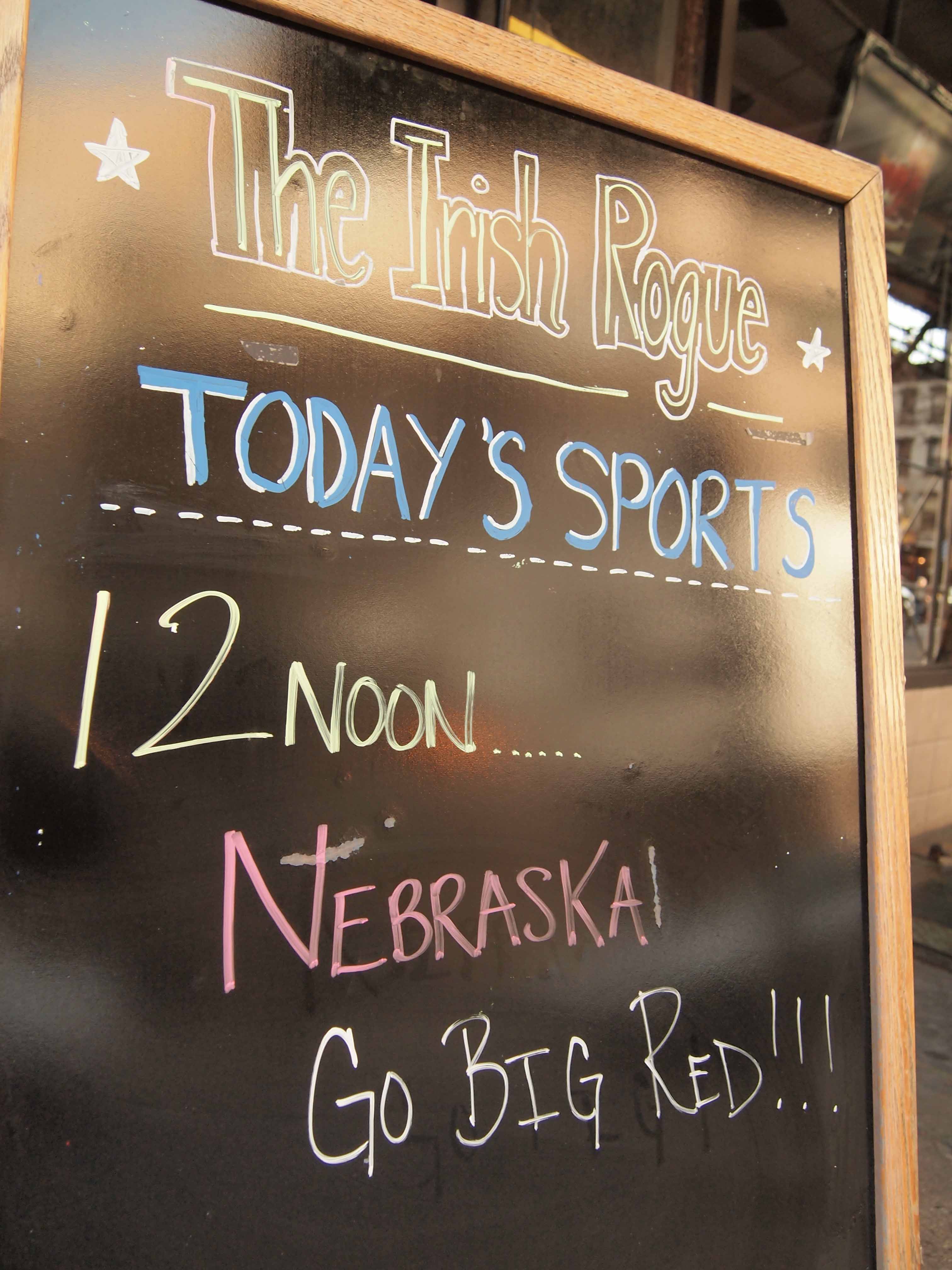
Ah the sidewalk chalkboard calling all Huskers

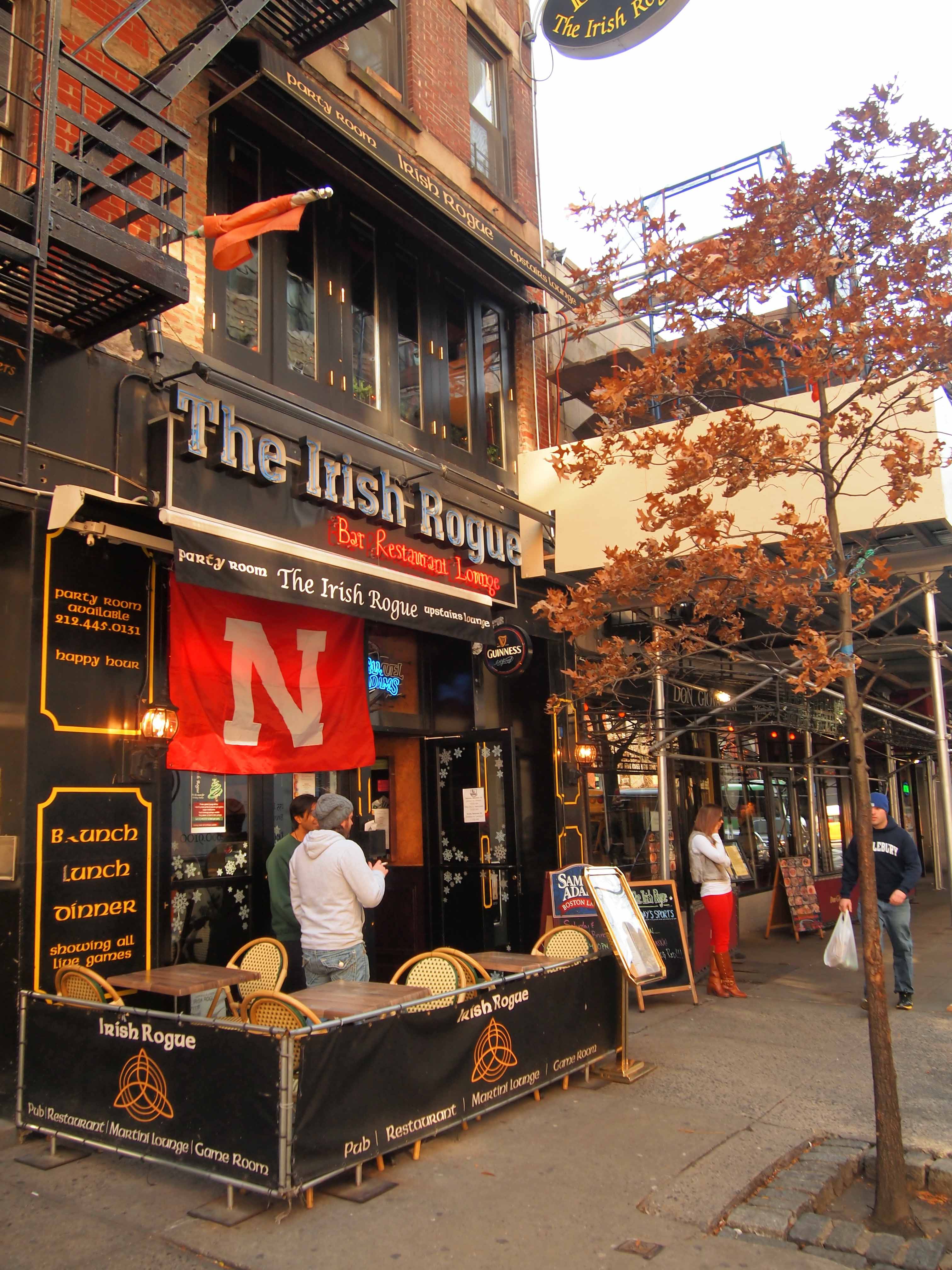
It’s an indisputable fact that there are very few programs in college football with histories at rich and storied as that of the University of Nebraska Cornhuskers.  Another commonly held fact is that few other – if any – fan bases travel as well as that of Nebraska (former Husker Roger Craig said once that if Nebraska scheduled a game on Mars that their fans would find a way to get there to see it in person).  They’re also known to be the friendliest and most polite fans known to college football, something which today seems to almost be a complete impossibility.  While I wasn’t able to travel to Lincoln to see my Buckeyes take on the Huskers in their first Big Ten home game I set out to confirm these things for myself at their New York City headquarters: The Irish Rogue.

For its first season in the conference the B1G and Mr Delany gave Nebraska the most challenging schedule it could come up with: Wisconsin, Ohio State, Michigan State, Penn State and Michigan.  After a melt-down in Madison to kickoff B1G play they managed a miraculous comeback at home against Ohio State, then a few weeks later they thumped Michigan State at home and set back out on the road where they topped Penn State.  No team in the B1G since Penn State in 1994 had beaten Ohio State, Michigan and Michigan State in the same season, on this Saturday I joined the NYC Husker faithful as they took on Michigan in an attempt to match Penn State’s feat.

The Irish Rogue

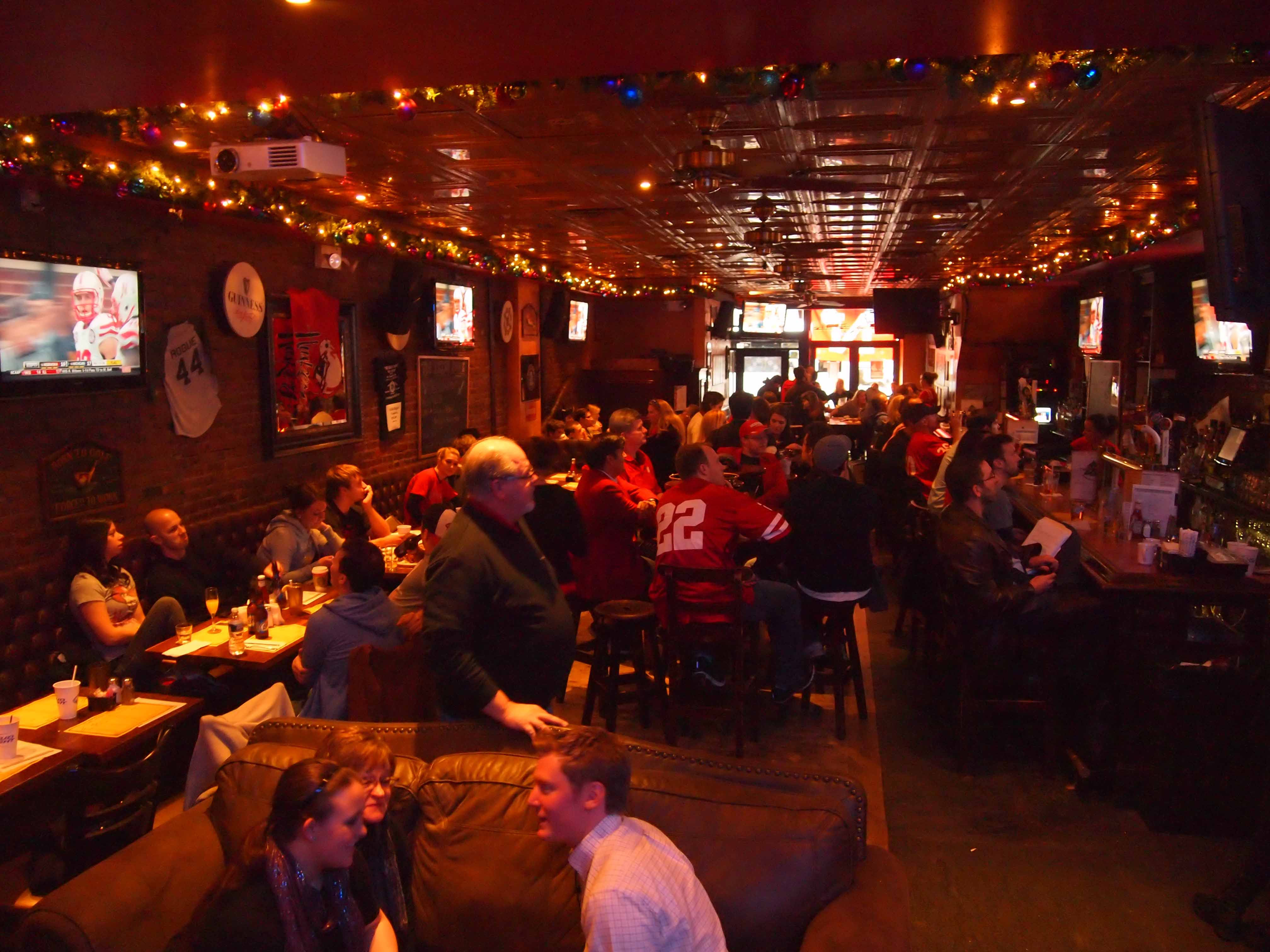
I will say that noon kickoffs can tend to be a bit rough, this is especially the case in New York City when you consider weekend subway commutes (any New Yorker will tell you weekends are even more difficult because of MTA repair-work schedules).  That said the crowd was a little late-ish to arrive and to a degree it never arrived at all.  I get that the Huskers are new to the conference and that they’re going through the whole getting to know the neighbors thing, but they were playing Michigan!

I was fortunate to find a spot at the bar and to quickly make a few new friends (one of whom was a Florida fan – that went to Florida State, strange world).  I was informed that that the lack of crowd was unlike most Husker game-watches at the Irish Rogue.  During the commercial breaks of the game on this Saturday we were made to actually watch and listen to them.  I was told that usually they do put music typical to the Nebraska Cornhusker culture on during breaks.  However this was the responsibility of the bartender and unfortunately this bartender was not going to be hassled with whatever Cornhuskers listen to.

A gathering of uber friendly Midwesterners

I was also disappointed to not hear a single Husker cheer, not even early in the affair when they were hanging with Michigan.  Based on what I understood from some of the patrons at the bar this may though have something to do with the culture of the fan base.  I asked what Husker fans are typically like and he asked what Ohio State fans are typically like.  We needed a common ground to sort this one out, we quickly arrived a Texas Longhorns fans, their former (hated) conference rivals.  He said Horns fans are total jerks.  I explained that in my experience from an OSU game in Austin (2006, Ohio State won 24-7) I found that they were anything but jerks!  My Husker friend went on to tell me that even when the team doesn’t play well in Lincoln the fans never boo or scream for a coaches head, but this also means that the stadium environment can tend to be quiet, just as I discovered at the bar.  He somewhat lamented this reality saying that he wishes at times Nebraska fans would be more intense.  My two cents: there’s nothing wrong with being too friendly and hospitable.

Ultimately and sadly there was very little for the Huskers inside the Irish Rogue to cheer about on this Saturday afternoon, the game slowly got away from Bo Pelini’s team and they badly lost to Michigan 45-17.  However I will certainly make it a point to get back to the Irish Rogue for a more lively game-watch experience and another opportunity to share company with the quintessential Midwesterners that are Nebraska Cornusker fans.

~Kurt

This is a guy I was studying back in 2008 when I was learning why Florida wiped out  a much more talented (and yes speedier) OSU team in Jan of 2007.  I also studied all the recruiting, talent and coaches in the SEC in 2008/2009 and quickly found out the wins over the Big 10 were not matters of talent and speed,  but coaches and schemes.  There’s a reason for the SEC having the highest paid assistants.

The Urban Meyer Schemes and Way changing OSU forever more – a foray into the future of the ever changing face of American Football!

Back to the Future – Shotgun Football (A 100 year full circle starting early last century)

OSU’s failure to understand the full implications of the Spread and the BALANCE of the PS

The morphing of the Passing Spread into the Power Spread, seen as the illusionary death of the Spread Offense in College Football

A True Power SpreadThe Florida Gator/Urban Meyer Offense

Urban Meyer – more than just Offensive Schemes  He has learned from a lot of coaches – yes, even the Power Spread.  And he was a great Special Teams coach before anything else.  He has always delegated well, recruited well and paid attention to all the details required to produce top teams.  In fact, he has a lot in common with a former great coach here at OSU named Jim Tressel.  And like Tressel he tended to take on too much and not let his highly paid assistants take over when needed.

Here’s a scary thought – as good as Meyer was, he may be better now. He has made mistakes in the past – even mistakenly moving away from his own gem of an offense!  He has the experience of years now.   And if there was one element as a Head Coach that a Nick Saban had over Meyer it was the ability to let his assistants do their job and not give into the obsessional need to take over ever phase of the team.  Meyer says he has learned from his time off – I BELIEVE HIM – expect this detailed, smart, open minded coach to be a Saban like delegator making him the Coach of the Year for 2012!

~Drew

Kurt to Drew:

Read the link.  Skip to last bullet point if you wish.  Meyer has maintained a relationship with Coach Stud apparently…

Drew to Kurt:
I said it before and I will say it again – Miles is holding back Studs, just like he would have done with Krags and he did with Crowton.  With more control, Crowton would have most likely  ran more intricate passing spreads , but with only a little Power Spread mixed in – but at least he would have gotten rid of a lot of the once successful, but now outdated two back stuff and veer option football that Miles ran back as an OC at Oklahoma St in the 90s .  Krags would have also been more about the passing spread, but with a little more PS mixed in and staying more with one back sets.   Studs = PS ALL THE WAY, as he comes directly from the Urban Meyer lineage at Bowling Green.  

I know he’s an OL coach  and that could be a problem – but like I said – I keep an open mind –  he’s an individual and NO ONE has free reign to work the PS or any Spread at LSU with Miles in charge.

I tell you this I like some of the stuff I have seen from LSU’s scheming and play calling this year -but then all of a sudden it sucks again.  I know that Krag supposedly still has influence , but I cant help but think that Studs is working some good stuff into the LSU offense this year, but  as always, Mile’s insists at sticking with what “he knows” over and over and over again.  Mile’s is very successful in many aspects of being a Head Coach, from recruiting to motivation, but he’s not the up and coming offensive mind that he seemed to be in the 90s with Oklahoma State.  If there’s been one and possibly his only flaw at LSU its in his lack of any real focus on offense and his inability to forge his old school concepts on offense with what is happening today.

Put it this way – Meyer/Studs or Tressel/Bolshit – to run an offense?  Remember that a former Meyer protege at Florida, Stan Drayton, is already our WRS coach! He hails from Allegheny College in my area of Western PA and where my cousin went to school and played Hockey!

ONE REQUEST TO URBANPlease keep Fickell -who was turning into a heckuva Defensive Coordinator before the whole tattoo mess!

~Drew

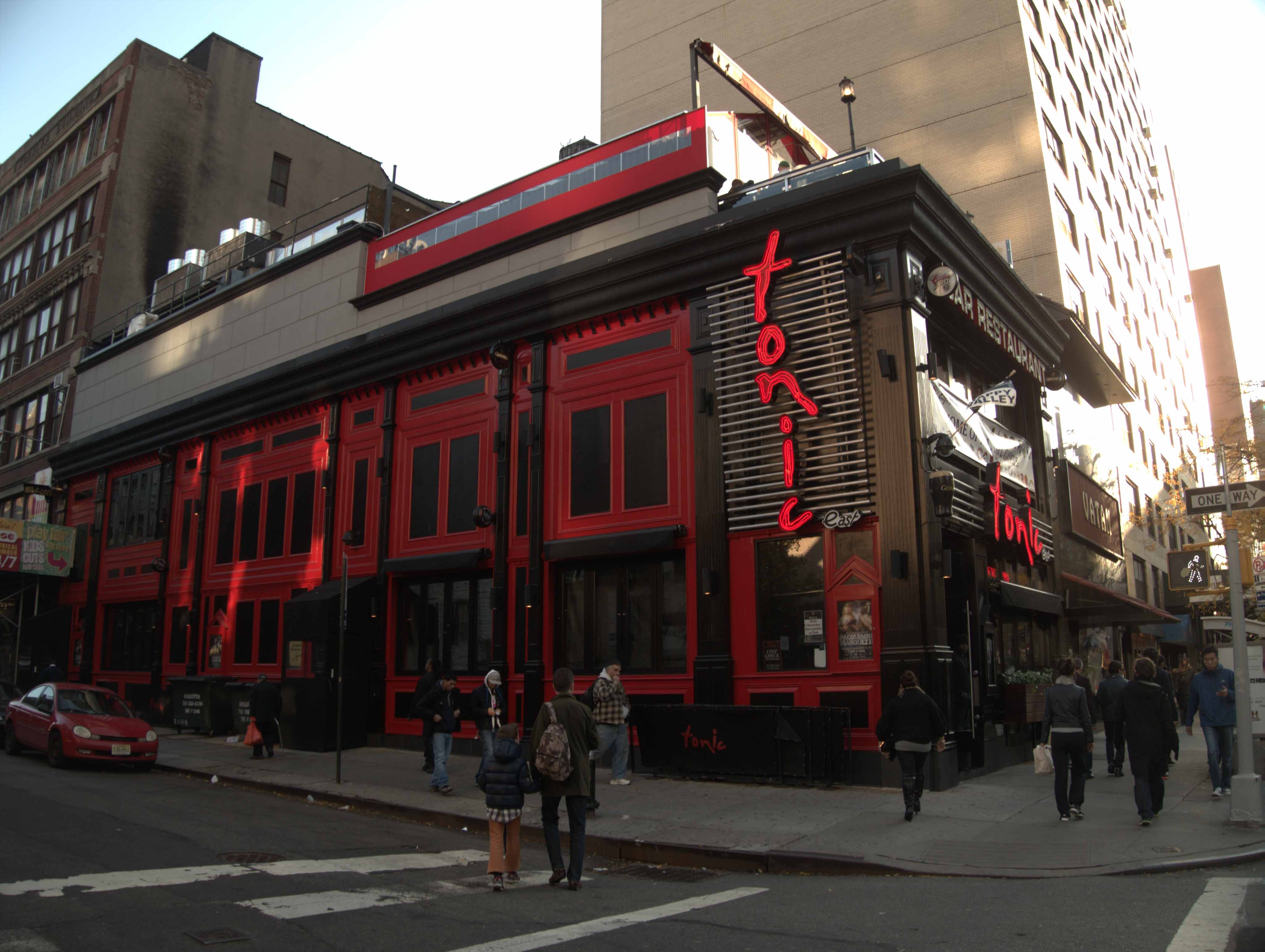
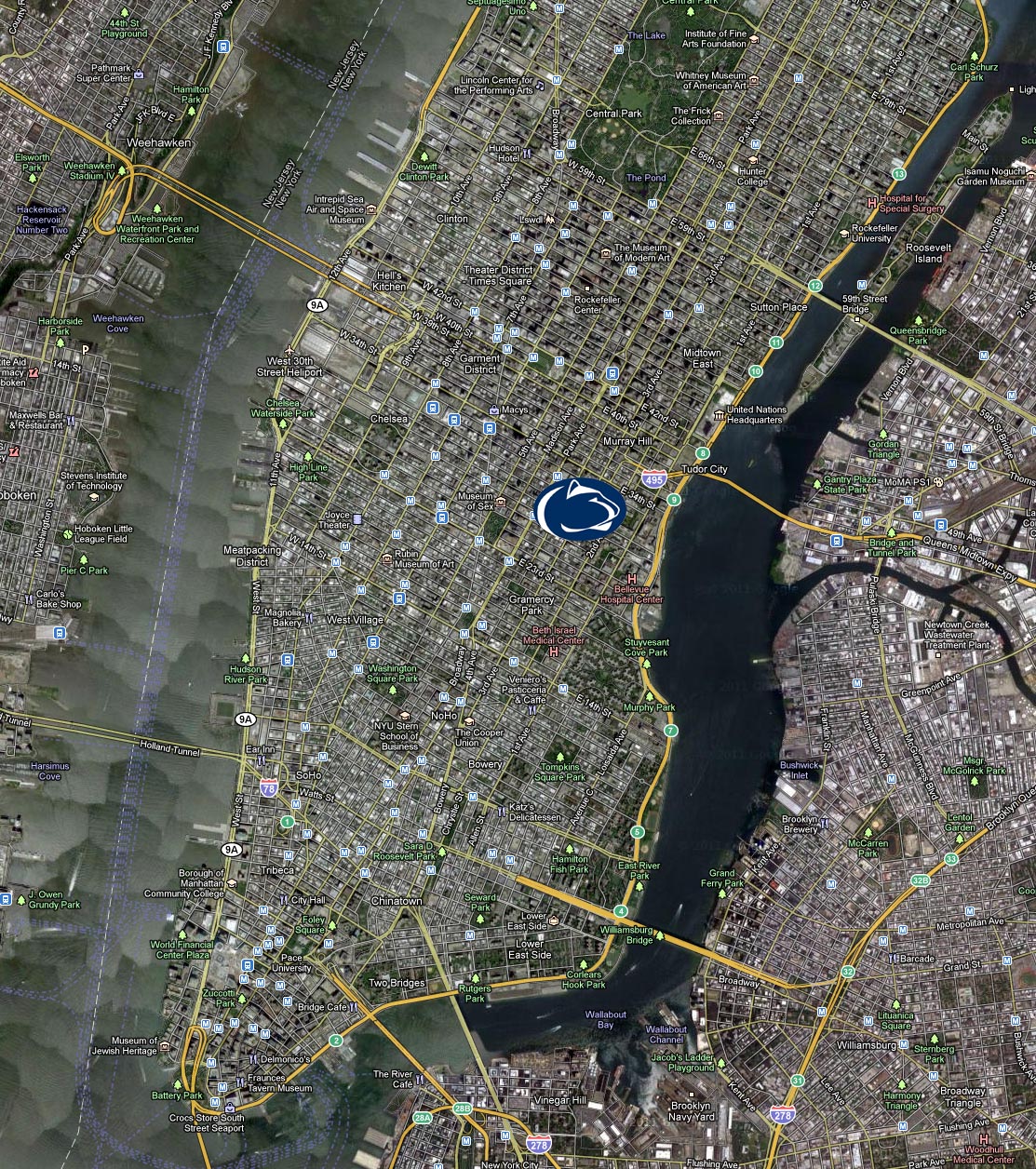
Tonic East, Penn State HQ NYC

Penn State has been the text-book definition of stability for nearly half a century.  Many things have come and gone in the world of college athletics and more specifically college football, but Penn State has always had stability in their head football coach Joe Paterno.  All of that changed in less than a week. On October 29th JoePa notched his 409th win topping the legendary Eddie Robinson, a week later former Penn State player and coach Jerry Sandusky was arrested on allegations of child molestation.  The walls which Paterno had literally erected himself over the course of 61 years at the university were closing in on him quickly.  By Wednesday night the board of trustees were forced to fire him, students rioted in the streets and all of the fully over-caffeinated news outlets figured out where State College in on a map, then arrived in droves beaming news across the globe.  All this, and yet there was still a crucial game against Nebraska to be played on Saturday.

Tonic East, Murray Hill, NYC

Make no mistake, I’ve always liked, respected and admired Joe Paterno, being an alumnus and fan of a rival school made no difference to me.  So as much as it was for anyone else, I also found it quite difficult to come to grips with the events of the week.  I decided I needed to go to the Penn State bar on Saturday to discover first-hand what their thoughts and reactions to the events were.

Too much first-half shutout? Have some sun with that $7 beer.

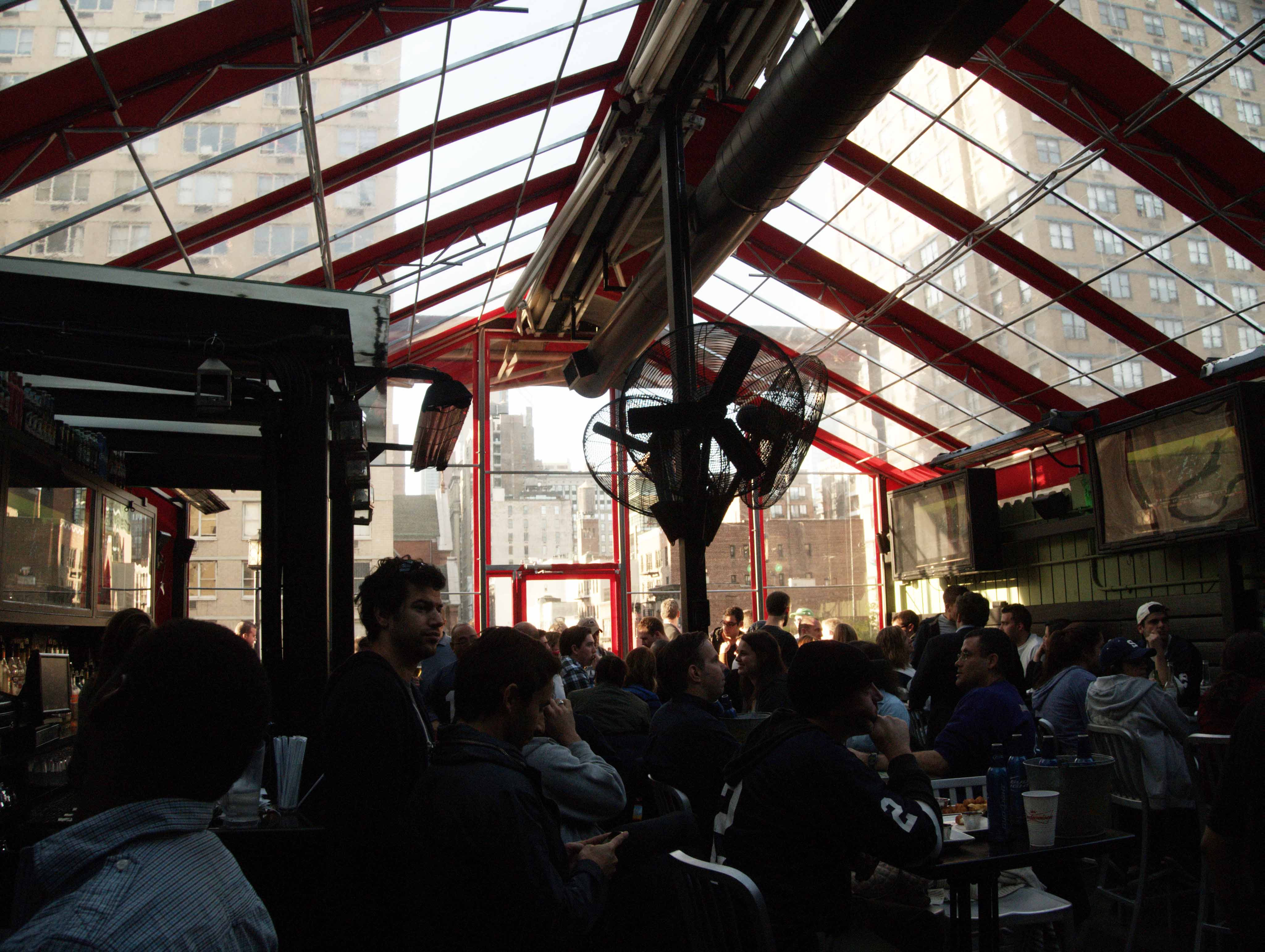
Penn State alums and fans gather at Tonic East in Murray Hill.  It is among the larger CFB underground bars in NYC: it has two stories of internal bar space and a third story which is a semi-enclosed rooftop space with an open-sky terrace with views west to the Empire State Building.

I arrived a few moments before kickoff and found the first floor to be absolutely packed.  The general pre-game vibe was not incredibly different than any I would expect it to be for any other game.  Except for one moment, when both teams broke the pre-game schedule for a prayer at midfield.  This was really, the only significant moment at the bar.

In contrast to LSU folk, the Penn Staters like some techno with their Livin’ on a Prayer (slightly ironic), and then they also have a tradition of singing Hey! Baby by DJ Otzi.  Yes, we’re nowhere remotely close to Baton Rouge.

Nittany faithful cheering on a 2nd half comeback

Penn Staters do not have issues with wearing jerseys in public.  Similar to my Buckeye brethren, they’re selective about what the number on the jersey means and who it represents.  One of the guys I met at the bar was wearing a #11 home blue jersey, and he made it clear that it was Lavar Arrington’s number.

Generally, the people I spoke with agreed entirely with the board of trustees decision to fire Paterno.  It was clear that they were shell-shocked by the turn of events, and sad to see their idol go down so unceremoniously.  Though there was some historical perspective in the mess: like Woody Hayes arriving home in a police car or Bobby Bowden’s awkward forced-retirement/pushed-out-of-the-way, just to name a couple.  We laughed that like those guys, Paterno could have never heeded Batman’s advice, to simply walk-off as a hero well over a decade ago, at least.

Tonic East rooftop bar

The Nittany Lions were en route to being shut out in the first half, much to the dismay of a friend I had made.  After a particularly terrible sequence of i-formation runs off-tackle for little to no gain leading to a punt he screamed I SWEAR SOMETIMES PATERNO’S STILL AROUND!  Then we got back to discussing more relevant matters, such as rumors about Urban Meyer having contacted a real estate agent in the Happy Valley area.

Being inside that bar, that day (especially as an Ohio State fan – they dislike us quite intensely) provided a very strange and also historical moment to glimpse into the world of expat Penn Staters in New York City.

~Kurt

Welcome to The Notes from the New York City College Football Underground!

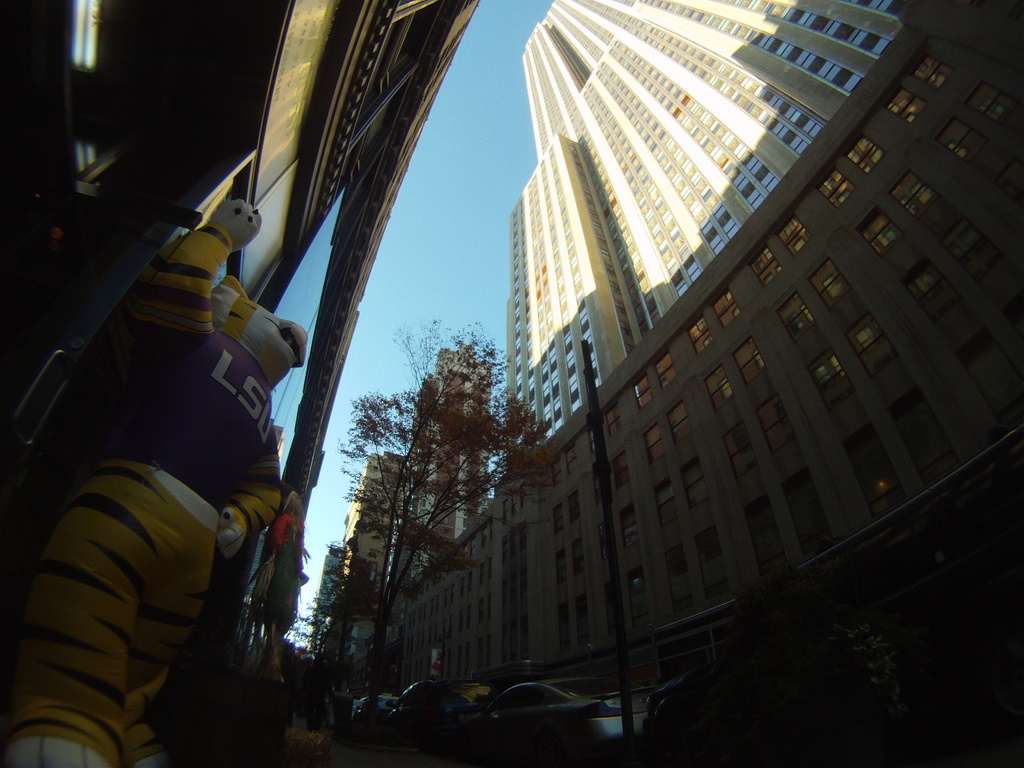
The Empire State Building does not intimidate Mike The Tiger

This past Gameday Saturday I discovered that Dante was unaware of another circle of Hell: SEC football; number 1 versus number 2; late in the regular season.

LSU entered the game undefeated (8-0) on the season and ranked #1 in every major poll.  Their opponent Alabama entered the game undefeated (8-0) as well and ranked #2 in all of the same polls.  They both find themselves in the SEC West, making this game effectively an elimination game for the SEC Championship Game.  The winner would have full command of their own destiny en route to the aforementioned SEC Championship Game with the ultimate goal being the BCS Championship Game (which will coincidentally be played in New Orleans).

I joined several LSU friends for this game.  From my perspective as an Ohio State fan committing to step foot inside their New York City outpost was very difficult.  In my ideal world neither team would win and a bolt of lightning would strike them both down.

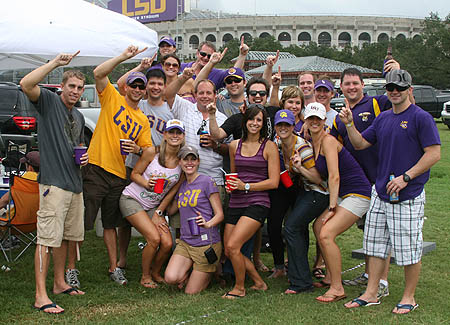
The bar in the city where all LSU folk gather is Legends on 33rd St across the street from the Empire State Building.  We heard the bar was expecting 500 people and the crowd reached that capacity an hour before kickoff.  A line formed outside on the sidewalk, and you could only get in if someone else came out–and no one was was going anywhere.

I dressed as neutrally as possible, jeans and a grey shirt, and of course my OSU ballcap.  This immediately ruffled the feathers of my friends who were naturally sporting their purple and gold in clever southern ways.  I’ve found that in the midwest we’re not subtle or particularly classy about how we display for the outside world our schools of allegiance.  Primarily we communicate it through the use of  jerseys.  In the south, it’s almost anything but a jersey.  And for women it’s all about the sundresses.  Old habits die-hard and it only takes a moment inside Legends, at the base of the Empire State Building in New York City, to become vividly cognizant of a complete and total culture shock.

While I am a general newbie to many things SEC, this was not my first experience of transplant SEC football in NYC (I’ve put in some time at the Auburn bar).  Who knew there were even a dozen LSU fans up here in Yankee Territory, let alone over 500!  Much like student seating in the SEC (or perhaps everywhere but Ohio State), there are no reservations at Legends, first come, first serve.  I arrived at 4 (4 hours before kickoff) and could not find a seat that wasn’t already spoken for.  I understood that people were showing up as early as 2, hawking the prime seating and tv viewing spaces in the bar.

Among other things that I did not know about LSU was their love of all songs (primarily country) involving keywords such as Baton Rouge, Louisiana, cotton, Eye of the Tiger and Don’t Stop Believing.  They really love them some Garth.  My ears were subjected to several renditions of Callin’ Baton Rouge.  Everyone sang it, and they sang EVERY.  SINGLE.  WORD.

Legends, lower bar

Finally, after hours of waiting, the game was about to get underway.  Per typical televised football game protocol, CBS introduced the viewing audience to each teams respective head coach.  When they popped up on the screen the face of Nick Saban, Legends sent off a chrorus of booing that could be heard from the top of the Empire State Building.  Then when they introduced us to Les Miles, well, Les is up there with Garth from what I gather.  The love-hate relationship from an outsiders perspective is a beautiful thing: Nick Saban rectified the program, and delivered their first National Championship in 45 years.  He was Saint Nick.  Now they hate his guts, and they’ve found a new love, Les Miles.

It wasn’t long before I started to piece together why this fan-base loves their current coach so much.  Jarrett Lee is not such a mobile type under center, so it wasn’t long into the game when he started feeling some intense heat from the Bama defense.  So on one particular play, with a Alabama defensive lineman about to put a punishing on him, Lee desperately heaved the ball out-of-bounds.  He still took a serious hit, but he did not take a sack and negative yards.  Tactically, a smart play.  One of my friends however, was not pleased with the play at all.  He said, “LEE’S GOTTA TAKE THAT HIT LIKE A MAN!”  To me, this explains everything they love about Les Miles: it’s not really about doing the smart or tactical thing, it’s about doing the manly thing.  The quarterback doesn’t just hand the ball off, they pitch it to the halfback then block the backside defensive end; his punter doesn’t just run the fake field goal in for a touchdown, he taunts defenders as they score – THE PUNTER!  They love Les because he’s created an alternate universe where the objective is just as much about kicking ass (as they chant after every first down) as it is about actually, winning.

So the game was billed the Game of the Century, and I wasn’t about to argue the topic with anyone Saturday night.  By the end of the fourth quarter Alabama was content to go to overtime.  LSU basked in the intensity of the game.  LSU held Alabama to a field goal attempt which was blocked.  They could taste victory, they had been outplayed on the night (again, a topic I was not about to bring up with anyone), but they knew victory was close.  Within a couple plays of their overtime possession they thought they had it won on a great run by Michael Ford.  The bar erupted and it took several plays for everyone to realize it wasn’t over yet.  Les appropriately centered the ball for the kicker.  Then this:

LSU won the Game of the Half-Century (as I’m calling it…this year).  Legends went through the roof.  And the bolt of lightning I had hope would strike down each team never came.  So I made my way through the jubilant Tiger faithful to the door where I re-entered New York City.  After experiencing Legends on this Saturday night I almost wonder if I really need to actually, you know, go to Baton Rouge!  Then I recalled what Legends had on their menu…and what I’ve heard about LSU’s tailgating food.  Yes, I hope someday soon I’ll be able to make a pilgrimage to Baton Rouge, although I’d really prefer to wait until a certain Ohioan is no longer their head coach.

~Kurt

With all the brilliant schemes now seen on the field, especially in College Football,  one can only imagine that Vince Lombardi would still use this famous line in a different context to describe what he was seeing in today’s game.   I was wondering myself for a while in 2007 and 2008 what exactly was happening on the field during the first decade of the new millennium. I always felt that Talent was everything in football – the most talented team always wins, right??   I was a huge lover of the NFL – all about the players (sometimes just the STARS) – without much awareness of anything else.  And back in the day when teams would stay together and not fling around the league year after year with only HUGE Salary QBs and a couple of other players remaining situated in he middle of this revolving door of new players every year. Back when I watched the NFL one felt like part of the team because all these great players were so familiar – they felt like a family amongst themselves and the fans felt like part of it.  There was no Fantasy Football as a sad substitute to feel a part of something greater than ordinary life.  At least I had the slight awareness to know it wasn’t ONLY about the QB and the STAR PLAYERS.   I knew that it took a lot of different players to build a winning team – lineman, dbs, etc and not just the QB that “WINS” Super Bowls. After moving to Pittsburgh I was amazed out how Terry Bradshaw was the “WINNER” of 4 Super Bowls, when he was surrounded by a Hall of Fame lineup on both sides of the ball.  In fact, many a pass was thrown up blindly by this Southern boy with the big arm, knowing he had the most athletic pair of receivers in the game who would bail him out every time.  To this day I still love talent first – as so many do who still watch the NFL and refuse to accept the development of any new schematics entering the game — but thanks to rampant free agency and a lack of loyalty I moved away from the NFL and studied the GAME itself more, having a better understanding of what I am actually seeing — not just a bunch of talented jocks running around and hitting each other –  there were other factors involved in wins and losses besides TALENT  – coaching, the program or organization and of course, team chemistry just to name a few. I actually started having an inkling of these “other” factors as far back as the 1980s with the help of my favorite NFL team, the Cincinnati Bengals, and their inability to win a Super Bowl despite their great TALENT.  My slight “jump” in awareness that there is something more to a team than just a great offense or defense was in the realization that Special Teams played a bigger part than most fans realized. The Bengals had such fun and dynamic offenses with great QBs, but their Special Teams and, many times, their Defense always held them back.  Then I saw the same thing with my favorite College Football team, Ohio State, who, in the 90s,  had some of the best talent in the Country and great Defenses to go with great Offenses, but break downs on Special Teams that cost them.  Of course, I was overjoyed at the detail and attention given to this part of the game of football when Coach Tressel came a long and led us to a National Championship.  Sure enough, we won many a close game during that  Championship run in 2002, due in many ways to the best Special Teams I ever witnessed from my favorite teams. Still, even after looking at the Coaching, Special Teams, Chemistry, etc, I was missing something and as I got further away from the NFL in the 00’s and started watching more and more College Football – not just Ohio State games. Then came the ignominious season of 2008 – the year we were supposed to have one of our greatest teams ever, rivaling the great 1998 team.

It was early in that year that I ran across possibly the hardest game I ever had to watch – and I watched it over and over and over again, until I finished analyzing and recording every single play of the game.  This is the September debacle where my beloved Buckeyes were blasted by my most hated team on the planet (possibly more than Michigan) – USC…..ugh!   I knew the talent on both teams – I had already studied these players as HS recruits – there was no clear edge.  In some spots USC had the talent edge, but in others it went to the Buckeyes.  Experience was actually on the side of the Buckeyes that year as most their top players surprisingly came back from the great team of 2007.  The Coaching could be called a tie or arguably in the Buckeyes favor and the our Special Teams was annually better than USC’s Special Teams, which were not always a main focus of Pete Carroll teams.  Lastly, the chemistry. The camaraderie that existed on our team was second to none as they fought thru a rough year of failed expectations, never quitting and always keeping their heads up with class.

So based on the final score I was completely in error with most or all of the above observations OR there was still a missing element I wasn’t seeing.   It wasn’t long into my obsessive post game analysis that I started to realize this “missing link”SCHEMES!   That was it – pure and simple .  The schemes run by USC’s Offensive Coordinator, Steve Sarkisian, were so ahead of our Defense – in terms of everything – from the use of multiple sets and  formations to all kinds of pre-snap shifts and motion – even  variations in the use of the game clock and snap counts.  We were so off balance on defense that we looked as slow as a 1980’s High School team.  And when our distraught players lost all confidence and began to hesitate on every play, we not only looked slow, but weak as well as we were blown out of holes by players of the same size, strength and speed.  Most fans concluded, as they had throughout most of USC’s reign, that their athletes were far superior. This was easy to disprove in he 2nd half as young Luke Fickell became more involved as a Defensive Coordinator in that 2nd half and made some wise adjustments in an effort to put our players in much better positions to stop this brilliant offensive scheme of USC.  Suddenly, as the playing field was leveled, our athletes looked every bit as fast  as USC, if not faster, and actually were able to keep the score from getting ridiculously out of control as USC stayed really aggressive on offense until late in the 4th quarter.   Unfortunately it was too little too late as our Offense never made a schematic adjustment to counter the much more aggressive schemes of USC’s defense. Our underrated offensive talent was left running for their lives, under constant pressure by a defense that seemed to know every play we were about to run.  It could be argued that we had the better team that year – we were massacred in schematics – and it was then that I started studying our schemes week after week and by the following year in 2009 I was studying all the schemes across the Country.

As I looked around it didn’t take long to notice some of the Read Option stuff that Sarkisian was running being used all over the place.  And, unlike the complicated brilliance of Sarkisian’s Multiple Offense, there were a lot of Spread Schemes out there that used a lot of Read Option runs over and over to great success. I started studying why these runs were so successful and so consistently maximized the talent on the team. It was pretty simple – use ALL OF THE FIELD and ALL OF THE PLAYERS including the QB in misdirection to keep the Defense off balance.  Some teams such as West Virginia or Navy didn’t pass much from their schemes, while others really mixed in both, such as Northwestern, who constantly seems to fluctuate between a Passing Spread and a Running Spread.  I finally came up with the term Power Spread and I wasn’t talking about the gimmicky offensive schemes seen throughout football history. I didn’t even use the term to mean Scheme — instead I was thinking of a concept or idea.   It incorporates all of football history from the Single Wing to the T Formation to the Pro Sets to the Run and Shoot, to the West Coast and to the Passing Spreads.

It’s schemes can be Pistol, Wildcat, Zone Read, Triple Option or just the Passing Spreads that have been used for a while: Run and Shoot, Air Raid, Fun Gun of Spurrier , Norm Chow’s BYU spread, Bubble Screen spreads of Gary Crowton or the more complicated NFL type passing spreads of Petrino, Weiss, etc.

Now when I say Power Spread I’m not talking just SPREAD – there are two words to this phrase – you can’t leave out the POWER.  IF you think about it  – it’s an oxymoron – because how can Power and Spread be used together?  To me it means – UTILIZING  THE WHOLE FIELD,  ALL THE TOOLS OF THE GAME AND PLAYERS ON THE FIELD – A   PERFECT BALANCE.  This includes misdirection and every player, except the lineman,  as an offensive threat.  Every coach knows that you can’t defend BALANCE because you cant defend EVERYTHING. I call this the Accordion effect.  Like an accordion the Power Spread “spreads” to where the defense ain’t.  Short, long, middle, wide.  Run or pass it doesn’t matter.  It doesn’t have to include option or a running QB – though this is helpful because with a running QB you have utilized 11 players instead of 10 – so there’s more balance.   You don’t have to run the  option or mis-direction, but again when you do this there’s just so much balance — you utilize  more players and more field when you have mis-direction or play action and it opens holes in the defense as they try to search for the ball amongst all the players from all over the field

Now some teams use speed to open up the whole field – Auburn and Oregon. Some teams use the POWER part of the term more – Alabama with its Pistol and Wildcat formations just pound on teams!  Also, Villanova may be the absolute definition of the POWER SPREAD with every one of their lineman over 300 lbs (in the FCS!) and they just spread the field and pound the Zone Read up the gut over and over until the defense stops it. Then the do play action and quick throws to loosen the defense. Then go back up the gut!  IT’S THE GREEN BAY PACKERS OF VINCE LOMBARDI IN SPREAD RUNS!

Not only does the Power Spread incorporate all the PLAYERS and the whole FIELD, but it also incorporates the whole HISTORY of Football in the most balanced offense ever.  In fact, Gus Malzahn and Chip Kelly’s schemes at times look like the 1920’s Single Wing with 4 running backs in the backfield and all kinds of mis-direction hand offs and fakes. The HUGE difference is that today we can add the passing game to that. The Single Wing eventually went away because it was easier to pass out of the T Full House Formation and then even easier out of the Pro Sets of the 60s and 70s.  Eventually we went to passing spreads starting first with the Pro Sets of the West Coast Offense, then the Run and Shoot, the No Huddle of the Buffalo Bills and finally the Pro Passing Spreads of New England and Indianapolis. But NOW,  some smart coaches in college determined that running the ball between the tackles out of these spread formations killed a defense and we have come full circle all the way back to the original single wing mis-direction plays of the 20s.  But with passing — IT INCORPORATES EVERYTHING THERE IS ABOUT OFFENSIVE FOOTBALL. IT ENGULFS THE NFL SCHEMES BECAUSE IT INCLUDES AND EXPOUNDS UPON THESE SCHEMES.

The only chance of stopping these schemes is by luck, a huge talent edge (which rarely exists anymore in college football) or by the PASSIVE AGGRESSIVE defensive schemes. Nick Saban made this popular with his Zone Blitz schemes – looks aggressive, but isn’t too aggressive. See, how do you beat the most balanced offenses in the history of football? With the most balanced defenses. Aggressive but not too aggressive.  The ILLUSION OF AGGRESSION.  You show an aggressive look,  but play zone or give the illusion of  deep zone,  but unload a surprise blitz, like when your linebackers drop into coverage, but blitz the nickel back and safety. You play man to man on the corners but deep zone in the middle. You play zone short but man to man with safeties – and on and on. The PHANTOM DEFENSE is the epitome of this – NO DOWN LINEMEN – nada! – everyone standing and there’s no way to know where the pressure will come from OR even if there will be any pressure at all?

We are going to see this cat and mouse game for the next decade not only in college but also in the NFL

And besides the whole use of the Field and the deception and involvement in all he players on the Field, there will also be more players used off the BENCH as well!  Substitution like we never have seen before is going to start happening. It’s already started on defense because of the hurry up offenses.  Defenses basically start 22 players now – no 2nd string – because they need to be fresh. Nick Aliotti’s idea of using a DE in coverage may have been a good one in the title game against Auburn (I think Urban Meyer liked it but Nick Saban didn’t), but we will never know — why??? — because the guy was totally winded. Oregon did not have the defensive depth of talent it needed to sufficiently defend the Hurry Up Offense. They had 15 players when they needed 22. Same thing applies to the offense – as the QB’s and RB’s get hit more because of more plays run, there will be a need for substitutions – yes even the QB’s!!  There is a lot of talent out there – plug them in the system – 4 good QBs over 1 great one may not work for TV ratings, but if the team is able to switch the parts, because the Scheme is so good and the team starts winning – fans will soon take affection to their multi-headed QB.  FOOTBALL IS THE ULTIMATE TEAM SPORT AND COACHES ARE STARTING TO REMEMBER THIS – ONE OR TWO GREAT PLAYERS CAN BE TAKEN DOWN BY A GREAT TEAM!

As we start using 50-70 players a game in College Football,  the NFL coaches are going to take notice – why? – simple – INJURIES.  Substitution reduces injuries and keeps the team stable for the season. Injuries don’t just take away good players – it hurts the continuity of the TEAM!  It’s better to play more players and keep continuity.  Once the NFL starts winning by using more players they will see the advantage of having extra QB’s (like the Steelers last year) then the running QB will start happening in the NFL. When the wins start piling up the NFL will embrace the change.

Now this idea embraces the TEAM and takes away from the STAR which the NFL builds its livelihood on. about. The only reason I think this type of system may happen in the NFL anyway is because of the efficiency and simple brilliance of this incredibly balanced concept. It’s so hard to stop and yet so simple. The defenses have to somehow counter with the same great balance back at the offense.  So you need the WHOLE TEAM just like you need the WHOLE FIELD and not just ONE GREAT PLAYER or ONE PART OF THE FIELD. All of the all-time greats like Lombardi,  Halas and Brown would have loved this concept of football because they KNEW that it’s about TEAM and  that “winning isn’t everything – its the ONLY THING.”

~Drew

Power Spread is a term I came up with a couple of years ago.  Its a Concept – utilizing different schemes to produce Power Football from a Spread Formation.   Today we see lots of these schemes, the most well known at present is probably the Read Option – Where the QB is lined up in a shotgun and reads the defense on the move with the ball at the RBs side until the last second when the decision is made to let the RB take the handoff or a QB keep.  A sub-scheme off of the read option is possibly the most famous of all Power Spread schemes – the Zone Read.  The Zone Read actually combines the use of zone blocking (made famous in the 1980s with such teams as Glen Mason’s Minnesota Gophers) with the Read Option.  West Virginia, coached by Rich Rodriguez, had great success with speedy players to make this scheme hugely popular in the 00s.

The Pistol formation is the other popular scheme in the Power Spread.  This scheme has the QB positioned not so far back from the center as in the shotgun – thus its called Pistol – a smaller gun.  From this “half” shotgun position there can be a RB positioned behind the QB as a Tailback in a pseudo I formation. There’s other variations with 2 backs, split backs, even triple backs in some sort of pseudo Single Wing from the 1920s!  But the idea is to have the rb or rbs somewhat hidden and useful in mis-direction, while still keeping the field spread and the QB in great position to either run or throw.  The great idea about the Pistol is that the QB can be much more protected than in the Read Option where he’s constantly vulnerable.   The pistol can be run either with a mobile , semi-mobile or even a non-mobile QB.  Just depends on the play creativity from the different Pistol sets.

The other Power Spread Scheme that needs mentioning is the Triple Spread Option, invented by Paul Johnson while at Georgia Southern in the 1980s.  It may look like old fashioned Veer Option(Oklahoma) or better yet, Triple Option football (Nebraska) of days gone by, but its really a semi-spread or spread set (depending on the width of the Wingbacks) disguised within a Triple Option scheme.  In fact, their is only the QB, under center, and one RB – so its basically a One RB set, which is usually a Spread set.  But in this case, two of the four WRs are lined up in a close to the Oline, slot position, called Wingbacks — again harking back to the Wingback formations of the early part of the last century.  Paul Johnson took this scheme to Hawaii, then made it really famous at Navy and now Georgia Tech.  While at Hawaii, he tinkered with spreading the Wingbacks out a little wider as Slotbacks and/or lining up or motioning into 3 players to one side of the field with a Wing, Slot and WR and passing a lot more out of what looked like purely a run option offense.  Thus, Triple Spread Option , Triple Option Spread or Spread Triple Option – whatever suits your fancy.

Actually, when Paul Johnson spread his Wings wider into Slot position he actually turned his Triple Option set into one of the first “famous” passing spread sets in football history and ironically the first Power Spread scheme of the modern age – The Run & Shoot!  Started by Mouse Davis at Portland State in the 1960s and made famous by Jim Kelly and the Houston Gamblers of the USFL in the 80s and finally by Warren Moon and the Houston Oilers of the NFL in the 90s,  the Run & Shoot was a quick pass, passing spread with the QB under center and utilizing half rollouts right OR left on every single play!  The set and WR patterns were so simple it was brilliant. Everything was based on WR and QB reads.  Like the Triple Option, the scheme requires great cohesion, so it must be run exclusively so without any other schemes or concepts involved so that the right level of execution can be achieved.

The Run&Shoot had something in common with the Power Spread Concept from the start-  brilliant simplicity in maximizing talent.   You didn’t need to be a star WR or even a WR by trade to play in this scheme.  In fact the Slot Backs who caught the most passes were usually converted RBs or scat backs with a lot of speed and decent hands.  Still, the QB position was not so flexible in this regard as the quick thinking passer with a fast and accurate “arm”  was  required for the best success. But the overall simple brilliance of the scheme finally brought out the first real Modern Day Power Spread scheme when the Detroit Lions were the first NFL team to consistently use the Spread to Run concept when they highlighted Barry Sanders in this Run&Shoot package during the same time that Warren Moon was zinging passes all over the field for the Oilers.  This development came about as so many do in sports – due to necessity – Barry was an incredible runner, especially in the open field and Rodney Peete did not have the strongest or most accurate arm.  In fact Peete was probably a better runner and actually took advantage of the “spread sets opening the field” to take off and run a lot more than the usual passing spread or West Coast QBs of the time.  But in the end it was all about Sanders and spreading out the field to let him find the seams. Of course, when teams ganged up too much on Barry it was a lot easier for Peete to find his WRs, regardless of his limitations as a passer.

As with the Run&Shoot of the Barry Sander Detroit Lions, always the Power Spread is about the threat of the run first, unlike the passing spread sets or even the spread concepts of earlier days with the Bill Walsh West Coast Offense. These are all “pass first” concepts as opposed to the older and more traditional “run first” styles of the Pro Two Back Sets that started in the 60s and continue to this day or the  Full House sets that dominated football from the 30s thru the 50s (though Dutch Meyer is credited with the first Spread Sets in College Football at TCU in the 50s).   All of these sets utilized the QB under center, which in the 30s was a revolutionary idea as early football was usually played with the Center snapping the ball back to someone at a certain distance away.   And if you look at the old Single Wing sets of the 20s and earlier it looks like, at least in College Football, that history has made a full circle back to the future with the Power Spread.  Back in the 20s and earlier,  the forward pass was still a novice idea and most of the scheming consisted of an overwhelming layer of misdirection utilizing all 4 backs in a contained set.  They were not spread sets, but still utilized the backs and ends in a multitude of formations with the same run first mentality and great use of misdirection involving EVERY player including the QB!

And this leads me to my last point about the  Power Spread.  This is not a gimmicky concept or gimmick schemes.  It utilizes every player at a team’s disposal – not leaving the QB out as a function of handing the ball off and getting out of the way.  Or setting up in obvious situations in 2 back sets where the FB always blocks and the TB always gets the ball. OR even obvious situations in passing spreads where the threat of the run is almost nil.  The Power Spread is designed as run to set up the past like the old schemes of days gone by, BUT , and here’s the key – THE POWER SPREAD CAN BE USED IN ANY WAY THE TEAM, TALENT AND COACHING DEMANDS.   It can also be used as a pass first offense if you so desire as was the Barry Sander’s Run&Shoot scheme that so confounded defenses.  They had to protect the pass, because of the Slotbacks spread out so wide , even though they knew the great threat at RB.  The mis-direction schemes at the beginning of last century did not involve any passing expertise you see today.  But then neither did the early Full House or Pro schemes later in the decade, though the pass continually improved and finally exploded into a great weapon with the development of the West Coast and Passing Spreads of the 80s and 90s.  Now, in the 00s, finally a system developed where by its impossible to know whether its the pass or run which will be the greatest weapon on the team and how and where ALL the offensive players will be utilized.  THIS IS THE POWER SPREAD – ABSOLUTE BALANCE.

In the end the Power Spread is about nothing else, if not BALANCE.  As pioneers such as  Dutch Meyer, Mouse Davis and Bill Walsh discovered – the field can be spread horizontally as well as vertically and when the misdirection of the old Single Wing is brought into the equation the balance of this offense is so complete that its near impossible to stop – even with bare bones execution. And if the Team possesses a player who can throw the ball a little, then its simply impossible to stop at this time in Football History. Always, its run first out of the Power Spread, but its very easy to alternate to a pass first mentality  when the defense stacks the box and then back to the run. In fact, the field can be stretched deep, short, wide or middle – like a 4 way Accordion – continuing to counteract  the defense until the defense can no longer commit to any one part of the field or any one player. EVERY PLAYER MAXIMIZED, EVERY PART OF THE FIELD UTILIZED.  That’s the Power Spread and where Football continues to grow – from the Rugby style scrums of the 1800s, the Single Wing of the early 1900s, the T Formation Full House of the 1940s,  the Pro Sets of the 1960s and finally the Passing Spreads of the 1990s – this is just one more step forward in the Evolution of American Football – THE POWER SPREAD.

~Drew